

Mastering Electrical Measurements: A Guide to Wheatstone Bridges, Meter Bridges, and Potentiometers
MCQs, Fill and Blanks and Reasoning Assertion Question Wheatstone Bridge


Mastering Electrical Measurements: A Guide to Wheatstone Bridges, Meter Bridges, and Potentiometers
In the world of electrical circuit analysis, precision is everything. While standard multimeters are great for quick checks, they often introduce small errors by drawing current from the circuit they are measuring. To achieve truly accurate results—especially when determining unknown resistances or the Electromotive Force (EMF) of a cell—physicists rely on null deflection methods.
This guide explores three fundamental instruments that utilize this principle: the Wheatstone Bridge, the Meter Bridge, and the Potentiometer.
1. The Wheatstone Bridge: The Foundation of Balance
The Wheatstone bridge is a theoretical circuit configuration used to measure an unknown electrical resistance by balancing two legs of a bridge circuit.
How It Works
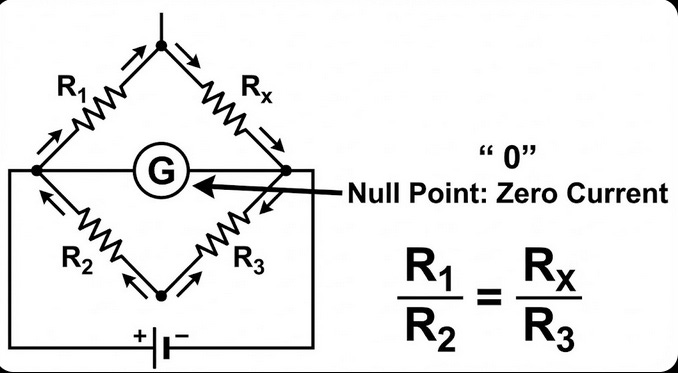
The circuit consists of four resistors arranged in a diamond shape. A galvanometer (a sensitive current detector) connects the two opposite junctions.
The goal is to adjust the resistors until the galvanometer shows zero current. This is known as the Null Point or Balance Condition. When the bridge is balanced, the potential difference between the two central junctions is zero.
The Balancing Formula
At the null point, the ratio of resistances in the known arms equals the ratio in the unknown arms. If Rₓ is the unknown resistor and R₁, R₂, R₃ are known, the relationship is:
R₁ / R₂ = Rₓ / R₃
This method is incredibly accurate because it relies on a “zero” reading rather than a calibrated scale, eliminating calibration errors common in standard ammeters.
2. The Meter Bridge: Wheatstone in Practice
While the Wheatstone bridge is the theory, the Meter Bridge is the practical laboratory setup used to apply it. It is essentially a physical realization of the Wheatstone bridge principle.
The Setup
The Meter Bridge replaces two of the resistors with a uniform resistance wire, typically 100 cm (1 meter) long, stretched over a scale. A sliding contact, often called a jockey or stylus, is moved along the wire to find the null point.
Calculating Resistance
Since the wire is uniform, its resistance is directly proportional to its length (R ∝ L). Instead of dealing with four resistor values, we simply look at the length of the wire on either side of the jockey.
If the wire balances at a length L₁ from the left side (where the known resistor R is connected), the unknown resistance S can be calculated using:
S = R × [ (100 - L₁) / L₁ ]
Key Application: This setup is widely used in labs to measure the specific resistance of wire materials or to identify faulty resistors in complex circuits without disassembling the whole system.
3. The Potentiometer: The “Perfect” Voltmeter
Measuring voltage (potential difference) seems simple—just connect a voltmeter, right? The problem is that a standard voltmeter has finite resistance and draws a small amount of current to work. This alters the circuit slightly, leading to a measurement error known as the loading effect.
The Potentiometer solves this by measuring voltage without drawing any current at the point of measurement.
The Principle: Potential Gradient
The potentiometer uses a long, uniform wire connected to a constant voltage source (driver cell). This creates a steady voltage drop along the wire, known as the Potential Gradient.
Think of the potential gradient like a staircase. As you move along the wire, the voltage drops in uniform steps. By measuring the length of wire needed to balance an external voltage source (like a battery being tested), you can determine its EMF precisely.
Why It Is Superior
Infinite Effective Resistance: Since the measurement is taken when the galvanometer reads zero (null point), the potentiometer effectively acts as a voltmeter with infinite resistance.
Zero Loading Effect: Because no current flows from the source being measured, the reading is the true EMF, not the terminal voltage.
The Equation
If a standard cell of EMF E₁ balances at length L₁, and an unknown cell E₂ balances at length L₂:
E₁ / E₂ = L₁ / L₂
4. Advanced Circuit Analysis: Spotting the Hidden Bridge
Understanding the machinery is one thing, but solving complex circuit problems in exams requires a different set of eyes. Often, examiners will disguise a Wheatstone bridge inside a complex shape, such as a square mesh or a triangle.
Here are three advanced concepts to help you decode these problems:
A. The Voltage Divider Perspective
Instead of just memorizing the R1/R2 ratio, think of the Wheatstone bridge as two parallel Voltage Divider circuits.
In a voltage divider, the voltage at the midpoint depends on the ratio of the resistors.
V_mid = V_total × [ R₂ / (R₁ + R₂) ]
If the voltage at the midpoint of the left branch equals the voltage at the midpoint of the right branch, the potential difference is zero. This is the true origin of the balancing condition.
B. The “Same Potential” Clue
In many exam problems (like the CBSE 2023-24 sample questions), you won’t see a diamond shape. Instead, you will see a text clue: “Points B and P are at the same potential.”
This phrase is a dead giveaway. If two nodes have the same potential:
Any resistor connecting them is effectively “shorted” (no current flows through it).
The circuit is acting as a Balanced Wheatstone Bridge.
You can apply the ratio formula immediately without calculating currents.
C. The Art of Redrawing Circuits
Complex circuits often look intimidating. A square wire with a cross-connection, for example, is just a Wheatstone bridge in disguise.
The Strategy:
Identify the nodes (junctions).
Place the battery terminals on the outside.
Place the “Same Potential” nodes in the middle.
Redraw the connections.
You will often find that a confusing “mesh” transforms into a clean, solvable rectangular or diamond bridge structure. This technique is essential for cracking high-level physics problems in JEE and NEET.
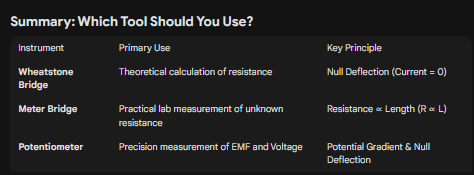
Summary: Which Tool Should You Use?
A Note on Accuracy
In all three methods, experimental error can creep in due to loose connections or reading parallax. To minimize this, it is standard practice to take multiple readings and average the results.
By mastering these three tools, you move beyond simple circuit checking and enter the realm of precision electrical engineering. Whether you are debugging a vintage circuit or performing a high-stakes physics experiment, understanding the null deflection principle is your key to accuracy.
Here are the NEET Physics MCQs based on the transcript, written out clearly for your practice.
Q1. According to the Article above, what is the most significant indicator in a problem statement that suggests a complex circuit can be analyzed as a Balanced Wheatstone Bridge?
A. The circuit contains a galvanometer.
B. Two specific points are stated to be at the same potential.
C. The circuit is drawn in a diamond shape.
D. All resistors have equal values.
Correct Answer: B
Explanation: If two nodes have the same potential, no current flows between them. This is the defining characteristic of a balanced Wheatstone bridge.
Q2. In the sample problem discussed (See Video), a uniform wire of resistance 4 Ω is bent into a square. If resistance is proportional to length, what is the resistance of one side of this square?
A. 4 Ω
B. 2 Ω
C. 1 Ω
D. 0.5 Ω
Correct Answer: C
Explanation: The square has 4 equal sides. Since the total resistance is 4 Ω and resistance is proportional to length, each side has a resistance of 4 Ω / 4 = 1 Ω.
Q3. The Article explains the Wheatstone bridge by comparing it to which simpler circuit concept?
A. Two voltage dividers connected in parallel.
B. Two capacitors connected in series.
C. A single loop inductor circuit.
D. A simple open circuit.
Correct Answer: A
Explanation: A Wheatstone bridge can be viewed as two parallel branches (voltage dividers). If the voltage at the midpoint of the left branch equals the voltage at the midpoint of the right branch, the bridge is balanced.
Q4. If points B and P in a circuit are at the same potential (VB = VP), what is the current flowing through a wire connecting B and P?
A. Maximum current
B. Zero current
C. Current depends on the resistance of the wire only.
D. Infinite current
Correct Answer: B
Explanation: Current flows from high potential to low potential. If the potential difference is zero (VB - VP = 0), no current flows, regardless of the resistance.
Q5. What is the standard condition for a Balanced Wheatstone Bridge with resistors R1, R2, R3, and R4?
A. R1 + R2 = R3 + R4
B. R1 / R2 = R3 / R4
C. R1 x R2 = R3 x R4
D. R1 - R2 = R3 - R4
Correct Answer: B
Explanation: The bridge is balanced when the ratio of resistances in one arm equals the ratio in the other arm (R1/R2 = R3/R4).
Q6. Why is it beneficial to identify a “hidden” Wheatstone bridge in a complex circuit problem?
A. It allows you to ignore the battery voltage completely.
B. It helps in calculating the temperature of the wire.
C. It simplifies the circuit by removing the central resistor from calculation.
D. It increases the total resistance of the circuit.
Correct Answer: C
Explanation: If the bridge is balanced, the central resistor (connecting the equipotential points) carries no current. It can be treated as an open switch and removed from the calculation, simplifying the network significantly.
Q7. The Meter Bridge mentioned in the transcript is a practical application of which principle?
A. Joule’s Law of Heating
B. Kirchhoff’s Current Law only
C. Wheatstone Bridge Principle
D. Faraday’s Law of Induction
Correct Answer: C
Explanation: The Meter Bridge uses a uniform wire to create the ratio arms of a Wheatstone Bridge in order to calculate an unknown resistance.
Q8. In the voltage divider analogy used in the video, if a 6V battery is connected to a 4 Ω and an 8 Ω resistor in series, how is the voltage distributed?
A. 3V across each resistor.
B. 2V across the 4 Ω and 4V across the 8 Ω.
C. 4V across the 4 Ω and 2V across the 8 Ω.
D. 6V across both resistors.
Correct Answer: B
Explanation: In a series circuit, voltage divides proportionally to resistance. Total Resistance = 12 Ω.
Voltage across 4 Ω = 6V × (4/12) = 2V.
Voltage across 8 Ω = 6V × (8/12) = 4V.
Q9. When redrawing a confusing circuit diagram, what is the best strategy mentioned to reveal a hidden Wheatstone bridge?
A. Draw all resistors in a single straight line.
B. Place the nodes at equal potential in the middle and the battery terminals on the outside.
C. Remove the battery from the drawing.
D. Replace all resistors with wires.
Correct Answer: B
Explanation: Arranging the “same potential” nodes in the center helps visualize the symmetry and reveals the parallel structure of the Wheatstone bridge (often looking like a diamond or rectangle).
Q10. If a Wheatstone bridge is “unbalanced”, what does the galvanometer reading indicate?
A. Zero current
B. A non-zero current flow
C. Infinite resistance
D. The battery is dead
Correct Answer: B
Explanation: In an unbalanced state, the potentials at the midpoints are different (VB ≠ VD), which causes current to flow through the galvanometer connecting them.
Fill in the Blanks
1. The Wheatstone bridge is designed to measure an unknown electrical resistance by ________ two legs of a bridge circuit.
2. When a Wheatstone bridge is balanced, the potential difference between the two central junctions is exactly ________.
3. The Meter Bridge is effectively a practical laboratory realization of the ________ principle.
4. In a Meter Bridge experiment, the resistance of the uniform wire is directly proportional to its ________.
5. A standard voltmeter draws a small amount of current from the circuit, introducing a measurement error known as the ________ effect.
6. Because a potentiometer measures voltage without drawing current, it effectively acts as a voltmeter with ________ resistance.
7. The steady voltage drop per unit length along a potentiometer wire is technically known as the ________.
8. To identify a “hidden” Wheatstone bridge in a complex exam problem, you should look for the text clue stating that two points are at the ________.
9. Conceptually, a Wheatstone bridge can be understood as two parallel ________ circuits connected side-by-side.
10. In the Meter Bridge formula S = R × (100 - L₁) / L₁, the term L₁ represents the ________ length measured from the zero end of the scale.
11. When measuring EMF using a potentiometer, the reading is considered the “true” EMF because ________ flows from the source being measured.
12. To minimize experimental errors such as loose connections or parallax, it is standard practice to take ________ readings and average the results.
13. The sliding metal contact used to find the null point on a meter bridge wire is technically called a ________.
14. In a balanced Wheatstone bridge, the ratio of resistances in the known arms is equal to the ratio of resistances in the ________ arms.
15. Complex circuit shapes, like a square mesh with a cross-connection, can often be simplified by ________ the circuit into a standard diamond shape.
Answer Key
Balancing
Zero
Wheatstone Bridge
Length
Loading
Infinite
Potential Gradient
Same Potential
Voltage Divider
Balancing (or Null Point)
No Current (or Zero Current)
Multiple
Jockey
Unknown
Redrawing
Reasoning and Assertion questions based on the article
Directions:
For each question, two statements are given: one labeled Assertion (A) and the other labeled Reason (R). Select the correct answer from the codes (a), (b), (c), and (d) as given below:
(a) Both A and R are true and R is the correct explanation of A.
(b) Both A and R are true but R is NOT the correct explanation of A.
(c) A is true but R is false.
(d) A is false but R is true.
Q1.
Assertion (A): A potentiometer is considered superior to a standard voltmeter for measuring the EMF of a cell.
Reason (R): At the null point, the potentiometer draws no current from the cell, effectively acting as an instrument with infinite resistance.
Correct Answer: (a)
Explanation: A standard voltmeter draws current, which causes a voltage drop due to internal resistance (loading effect). The potentiometer avoids this by balancing the circuit so zero current flows, measuring the true EMF.
Q2.
Assertion (A): The wire used in a meter bridge must have a uniform cross-sectional area throughout its length.
Reason (R): The working principle of the meter bridge assumes that the resistance of the wire is directly proportional to its length.
Correct Answer: (a)
Explanation: Resistance depends on Length divided by Area. For resistance to be proportional only to length (which is the core assumption of the meter bridge formula), the Area (A) must remain constant (uniform) throughout the wire.
Q3.
Assertion (A): Thick copper strips are used to connect the resistors and wire in a meter bridge setup.
Reason (R): Thick copper strips offer high resistance, which improves the sensitivity of the bridge.
Correct Answer: (c)
Explanation: Assertion is true: thick strips are used. Reason is false: thick strips are used because they have very low resistance. This ensures that the resistance of the connecting wires is negligible and doesn’t affect the measurement.
Q4.
Assertion (A): If the positions of the battery and galvanometer are interchanged in a balanced Wheatstone bridge, the bridge remains balanced.
Reason (R): The null point of a balanced Wheatstone bridge depends on the direction of the current flow.
Correct Answer: (c)
Explanation: The bridge remains balanced because of the “conjugate arms” property. However, the Reason is false because the balance condition (ratio of resistances) is independent of the current direction.
Q5.
Assertion (A): It is recommended to obtain the balancing length (null point) near the middle of the meter bridge wire (around 50 cm).
Reason (R): The meter bridge wire is typically 100 cm long.
Correct Answer: (b)
Explanation: Both statements are true facts. However, the reason we measure at the middle is to minimize percentage errors in measurement, not simply because the wire is 100 cm long. Thus, R is not the correct explanation for A.
Q6.
Assertion (A): To measure the EMF of a cell using a potentiometer, the EMF of the driver cell must be greater than the EMF of the cell being measured.
Reason (R): If the driver cell has lower EMF, the potential drop across the entire length of the wire will be less than the EMF to be measured, and no null point will be obtained.
Correct Answer: (a)
Explanation: You cannot balance a larger voltage (e.g., 5V) against a wire that only has a maximum drop of a smaller voltage (e.g., 3V). The balancing point would theoretically fall off the end of the wire.
Q7.
Assertion (A): In a balanced Wheatstone bridge, the galvanometer shows a large deflection.
Reason (R): Current flows from higher potential to lower potential.
Correct Answer: (d)
Explanation: The Assertion is false because a balanced bridge implies zero potential difference, and therefore zero deflection (no current). The Reason is a correct physical law, but it applies to unbalanced states.
Q8.
Assertion (A): Increasing the length of the potentiometer wire increases the accuracy (sensitivity) of the instrument.
Reason (R): A longer wire results in a smaller potential gradient (voltage drop per unit length), allowing for the measurement of smaller potential differences.
Correct Answer: (a)
Explanation: A smaller potential gradient means that a small change in voltage corresponds to a larger, more easily readable length on the scale. This makes the instrument more sensitive and accurate.
Q9.
Assertion (A): Current should not be passed through the meter bridge wire for a long duration.
Reason (R): Passing current causes heating (Joule heating), which changes the resistance of the wire and introduces errors.
Correct Answer: (a)
Explanation: Resistance changes with temperature. If the wire gets hot due to prolonged current, its resistance will change, and the linear relationship between length and resistance will no longer be perfectly accurate.
Q10.
Assertion (A): If points B and P in a circuit are at the same potential, the resistor connecting them can be removed for calculation purposes.
Reason (R): A Balanced Wheatstone bridge acts as an open circuit for the central branch because no current flows through it.
Correct Answer: (a)
Explanation: If the potentials are equal, the potential difference is zero. Without potential difference, no current flows. If no current flows, that specific wire/resistor has no effect on the rest of the circuit and can be effectively ignored (removed).