

Mastering Electrostatics: The Hidden Rules of Spherical Capacitors
The Hidden Trap in Spherical Capacitors: Why Boundary Conditions Matter

Physics problems often look simple until boundary conditions change the rules. Discover the difference between earthed and fixed potentials in spherical capacitors to avoid common exam traps.
Welcome back to the CRACKNEETPhysics – Selection Walla Channel blog! Physics problems often look simple until you notice the hidden twist: boundary conditions. For NEET and JEE aspirants, simply memorizing the formula C = 4πε₀ab / (b − a) for spherical capacitors will eventually cost you marks. Why? Because whether a sphere is earthed (locked at zero potential) or held at a fixed potential completely changes the physical reasoning behind the math. Examiners love to test this conceptual gap. In this post, we’re going to unmask the hidden rules of electrostatics, break down three classic spherical capacitor cases, and show you exactly how boundary conditions flip the logic.
⚡ Spherical Capacitors & Boundary Conditions: Conceptual Clarity Beyond Formulas
Physics problems often look simply until you notice the hidden twist: boundary conditions. In spherical capacitors, whether a sphere is earthed or held at fixed potential changes the reasoning, even if the final formula looks similar. Let’s break it down. Here’s a detailed note on boundary conditions
📘 Boundary Conditions in Physics: The Hidden Rules of Potentials
Boundary conditions are the rules we impose on a system’s surfaces or limits to solve physical problems. They define how fields, potentials, or forces behave at specific points, and without them, equations remain incomplete. In electrostatics, boundary conditions decide how charges distribute and how capacitance is calculated.
⚡ What is a Boundary Condition?
A boundary condition fixes either:
Potential: e.g., setting a conductor’s potential to 0 V when earthed.
Field/Derivative: e.g., specifying electric field at a surface.
They act like “anchors” for solutions, ensuring uniqueness and physical meaning.
🟢 Example: Spherical Capacitors
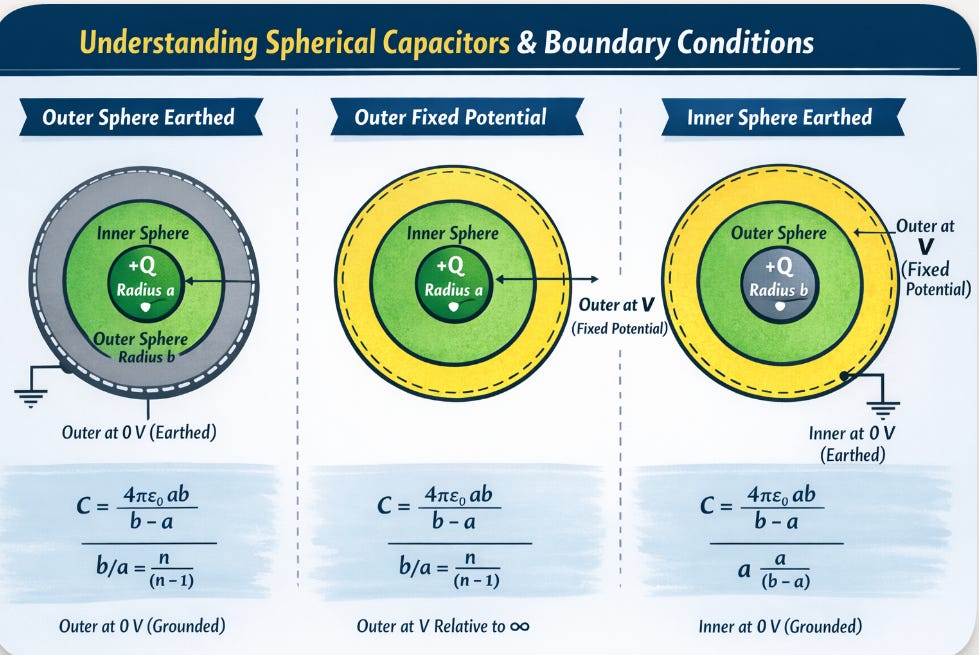
Outer Sphere Earthed:
Boundary condition: outer potential = 0 V (absolute reference).
→ Inner sphere’s potential is measured against this fixed zero.
→ Capacitance formula emerges directly: C = (4πϵ₀ab)/(b − a).Outer Sphere at Fixed Potential V:
Boundary condition: outer potential = V relative to infinity.
→ Potential difference must be explicitly calculated between inner and outer surfaces.
→ Formula looks the same, but reasoning is relative, not absolute.Inner Sphere Earthed:
Boundary condition: inner potential = 0 V.
→ Outer sphere’s charge defines the potential difference.
→ Capacitance again = (4πϵ₀ab)/ (b − a), but ratio is compared to outer sphere’s isolated capacitance.
🔑 Why Boundary Conditions Matter
They fix reference points for potential or field.
They decide uniqueness of solutions in electrostatics, mechanics, and wave physics.
They change the logic of problems even if the final formula looks identical.
Examiners use them as conceptual traps: students who memorize formulas without understanding boundary conditions often miss the subtle differences.
🎯 Takeaway
Boundary conditions are not just mathematical formalities — they are the physical rules that anchor solutions. Earthing sets absolute zero potential, while fixed potential requires relative calculation. Switching which sphere is earthed flips the logic entirely. Mastering boundary conditions means mastering the context behind the equations, not just the equations themselves.
Example Setup
Inner sphere radius a = 0.1 m
Outer sphere radius b = 0.2 m
Permittivity of free space ϵ₀ = 8.85 × 10⁻¹² F/m
Case 1: Outer Sphere Earthed
Capacitance of isolated inner sphere:
C₀ = 4πϵ₀a ≈ 1.11 × 10⁻¹¹ FCapacitance of spherical capacitor:
C = (4πϵ₀ab)/(b − a) = (4πϵ₀ × 0.1 × 0.2)/(0.1) ≈ 2.22 × 10⁻¹¹ FRatio: C/C₀ = 2 → capacitance doubled.
Boundary condition: Outer sphere potential fixed at 0 V (absolute reference).
Case 2: Outer Sphere at Fixed Potential V (say +10 V relative to infinity)
Potential of inner sphere: Vᵢ = Q/(4πϵ₀a)
Potential of outer sphere: Vₒ = Q/(4πϵ₀b) + 10
Potential difference ΔV = Vᵢ − Vₒ = Q/(4πϵ₀a) − Q/(4πϵ₀b) − 10
Effective capacitance: C = Q/ΔV
→ Numerically, the formula still reduces to (4πϵ₀ab)/(b − a), but the extra +10 V shift shows that the outer sphere is not at absolute zero.
Key Insight
Earthed: Outer sphere locked at 0 V → absolute boundary condition.
Fixed potential: Outer sphere held at +10 V relative to infinity → relative boundary condition.
The math looks similar, but the conceptual reasoning differs: in the earthed case, you measure against zero; in the fixed‑potential case, you must explicitly subtract the outer sphere’s non‑zero potential.
Alright, let’s carefully build the third case: inner sphere earthed, outer sphere charged, step by step, so your students can see how boundary conditions flip the logic entirely.
⚡ Case 3: Inner Sphere Earthed, Outer Sphere Charged
Step 1. Setup
Inner sphere radius = a, connected to earth → potential fixed at 0 V.
Outer sphere radius = b, carries charge Q.
We want the effective capacitance of this system.
Step 2. Potentials
Potential of outer sphere due to its own charge: Vₒ = Q / (4πϵ₀ b).
Potential of inner sphere due to induced charges: Vᵢ = Q / (4πϵ₀ a).
But since the inner sphere is earthed, its potential is forced to 0 V.
Therefore, the potential difference between outer and inner surfaces is:
ΔV = Vₒ − Vᵢ = Q/(4πϵ₀ b) − Q/(4πϵ₀ a).
Step 3. Capacitance Definition
C = Q / ΔV
= Q / [Q(1/b − 1/a)/(4πϵ₀)]
= (4πϵ₀ ab) / (b − a).
Step 4. Compare with Isolated Outer Sphere
Isolated outer sphere capacitance: C₀ = 4πϵ₀ b.
Ratio: C / C₀ = [ (4πϵ₀ ab)/(b − a) ] ÷ (4πϵ₀ b)
= a / (b − a).
🔑 Conceptual Difference
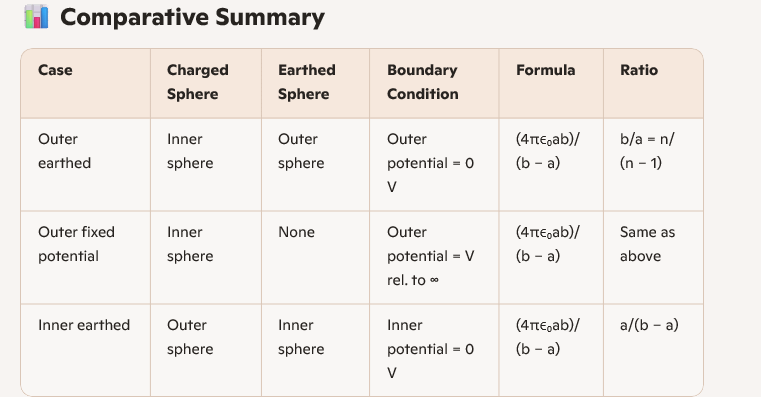
Outer sphere earthed: Inner sphere charged, outer fixed at 0 V.
Outer sphere fixed potential: Inner sphere charged, outer held at finite V relative to infinity.
Inner sphere earthed: Outer sphere charged, inner fixed at 0 V.
👉 Notice how the boundary condition flips the logic:
In Case 1 and 2, the inner sphere is charged and outer defines the reference.
In Case 3, the outer sphere is charged, and the inner defines the reference.
🎯 Takeaway
Boundary conditions decide which potential is locked and therefore how the potential difference is calculated. Even though the formula for capacitance looks similar, the ratio changes depending on which sphere is earthed. This is the subtle trap examiners love — same math structure, different physical reasoning.
🟢 Case 1: Outer Sphere Earthed
• Setup: Inner sphere radius a carries charge Q. Outer sphere radius b is connected to earth.
• Boundary condition: Outer potential = 0 V (absolute reference).
• Capacitance:
C = (4πϵ₀ab)/(b − a)
• Ratio: Compared to isolated inner sphere (C₀ = 4πϵ₀a), we get b/a = n/(n − 1).
• Key idea: Earthing fixes absolute potential, simplifying the calculation.
🟡 Case 2: Outer Sphere at Fixed Potential (Not Earthed)
• Setup: Inner sphere radius a carries charge Q. Outer sphere radius b is maintained at potential V relative to infinity.
• Boundary condition: Outer potential = V (relative reference).
• Capacitance:
C = Q / [Q/(4πϵ₀a) − Q/(4πϵ₀b)] = (4πϵ₀ab)/(b − a)
• Ratio: Same as Case 1, but reasoning differs.
• Key idea: Here, you must explicitly calculate relative potential difference. Formula looks identical, but the logic is different.
🔵 Case 3: Inner Sphere Earthed, Outer Sphere Charged
• Setup: Outer sphere radius b carries charge Q. Inner sphere radius a is connected to earth.
• Boundary condition: Inner potential = 0 V (absolute reference).
• Capacitance:
C = Q / [Q/(4πϵ₀b) − Q/(4πϵ₀a)] = (4πϵ₀ab)/(b − a)
• Ratio: Compared to isolated outer sphere (C₀ = 4πϵ₀b), we get C/C₀ = a/(b − a).
• Key idea: Switching which sphere is earthed flips the logic. Now the outer sphere’s charge defines the potential difference.
🎯 Why This Matters
Students often memorize capacitance formulas without noticing boundary conditions. But physics is about context:
• Earthing fixes absolute potential.
• Fixed potential requires relative calculation.
• Switching which sphere is earthed changes the reference point entirely.
👉 Examiners love these twists because they test whether you understand why the formula works, not just what it is.
Solved MCQ
An isolated sphere of radius a has capacitance C₀. When it is enclosed by an earthed concentric sphere of radius b, its capacitance becomes nC₀.Now suppose the outer sphere is not earthed, but instead maintained at a fixed potential V relative to infinity.
What is the ratio b/a in this case, if the capacitance of the inner sphere is still increased by n times compared to isolation?
Options:
A. n / (n − 1)
B. (n + 1) / (n − 1)
C. (n² − 1) / n
D. (2n) / (n − 1)
🧠 Given:
An isolated sphere of radius a has capacitance C₀ = 4πε₀a.
When enclosed by an earthed concentric sphere of radius b, its capacitance becomes nC₀.
Now, the outer sphere is not earthed but held at fixed potential V relative to infinity.
The capacitance is still nC₀.
Find the ratio b/a.
why the capacitance increases to nC₀ when the isolated sphere is enclosed by an earthed concentric sphere ?
⚡ Physical Reasoning
An isolated sphere of radius a has capacitance:
C₀ = 4πε₀a
This is based on its ability to hold charge relative to infinity.
Now, when you enclose it inside a concentric earthed sphere of radius b, something important happens:
The outer sphere is grounded, so its potential is fixed at 0 V.
The inner sphere is charged, and the potential difference is now between the inner sphere and the grounded outer shell — not infinity.
This setup forms a spherical capacitor, and the electric field is confined between the two spheres.
🧠 Why Capacitance Increases
Capacitance is defined as:
C = Q / ΔV
In isolation, the inner sphere must push its field all the way to infinity → large ΔV → smaller C.
With the outer sphere nearby and grounded, the field terminates at radius b → smaller ΔV → larger C.
The presence of the outer conductor lowers the potential required to hold the same charge, hence capacitance increases.
Mathematically:
C = (4πε₀ab)/(b − a)
Compare this to C₀ = 4πε₀a →
C = nC₀ ⇒ b/a = n / (n − 1)
🔑 Insight
The outer earthed sphere acts like a field terminator, reducing the energy needed to store charge. That’s why enclosing the inner sphere boosts its capacitance by a factor of n.
✅ Step 1: Capacitance of spherical capacitor (outer sphere earthed)
Standard formula:
C = (4πε₀ab)/(b − a)
Given:
C = nC₀ = n × 4πε₀a
So:
(4πε₀ab)/(b − a) = n × 4πε₀a
Cancel 4πε₀ from both sides:
(ab)/(b − a) = na
✅ Step 2: Solve for b/a
Divide both sides by a:
b/(b − a) = n
Cross-multiply:
b = n(b − a)
b = nb − na
b − nb = −na
b(1 − n) = −na
b/a = n / (n − 1)
✅ Step 3: Apply to the twist case
Even though the outer sphere is not earthed, the potential difference between the spheres is still:
ΔV = Q/(4πε₀a) − Q/(4πε₀b)
So effective capacitance:
C = Q / ΔV = (4πε₀ab)/(b − a)
Same formula as before — but derived via relative potential, not absolute zero.
✅ Final Answer:
b/a = n / (n − 1) → Option A